

'My Leg Has Got to Come Off': Amputations at Sea
During the many Pacific voyages documented in China, America and the Pacific, a regular feature was death and injury onboard the ship. Crew members shattered their skulls from falls, and had limbs mutilated by breeching whales. Many of these men faced immediate death, however a minority faced a punishment that was arguably far worse, as this extract from The Life of Tristram Coff[y]n shows.
In 1800 … in the capture of a large sperm whale, Captain Coffin’s leg was crushed … So he called for an instrument used in cutting whale’s blubber … and, bracing himself up on his couch, addressed his mate in this wise: “My leg has got to come off, or I shall die.”
Luckily for the many other men who had to endure the trauma of an amputation, larger vessels would have had trained practitioners onboard who brought with them a neatly organised set of surgical instruments, seen here. Similar to your family’s finest silverware, these knives only came out on special occasions, and just like those botched 80’s dinner parties, they were used to hack through tough, gristly flesh. The only difference, however, was that this was no leg of lamb, but a poor cabin boy who had chosen the wrong time to pick his nose when climbing the rigging.
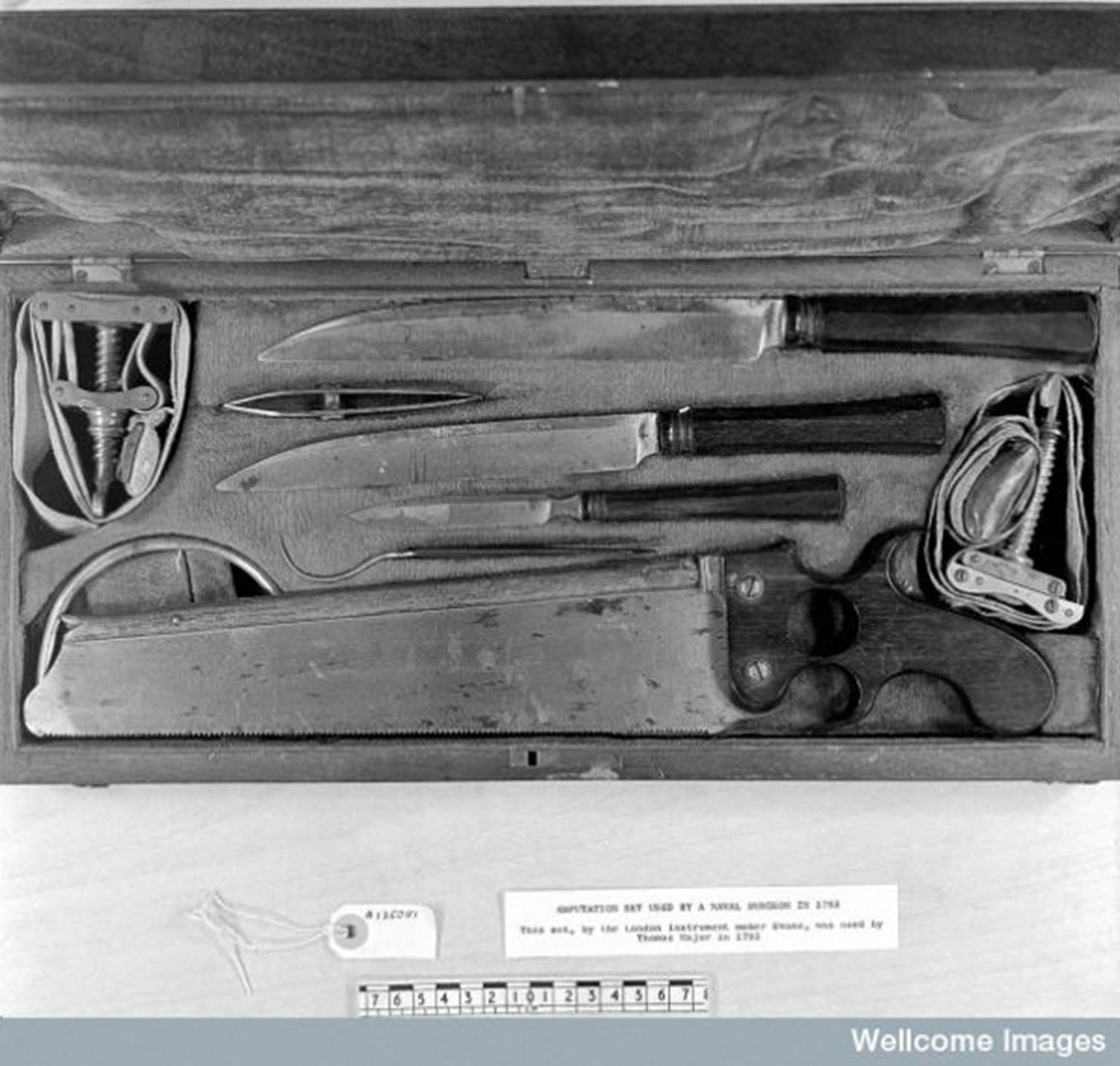
From surviving examples of these objects we can gain an insight into how naval surgeons would have amputated these limbs. With tourniquets screwed into place to prevent haemorrhaging, a curved knife, seen here at the top of the box, would cut through the many layers of flesh to get right down to the bone. The cute little double-edged blade would then scrape away any leftovers between the tibia and fibula, before the hefty saw hacked away at whatever was left. The small hook and tweezers could be used to locate and tie off any veins or arteries that were filling the decks with blood.
Shockingly, despite all of this high-tech equipment, the chance of survival wasn’t great. Even if the patient managed to endure the initial shock and blood loss, the dirt and grime of maritime vessels would have undoubtedly led to infection, as this delightful quote from a Shanghai newspaper explained: ‘Gangrene has set in, and maggots may be seen in an enormous cavity which has been formed.’ How lovely…
For more information about China, America and the Pacific: Trade and Cultural Exchange, including free trial access and price enquiries, please email us at info@amdigital.co.uk.
Recent posts

Noor Inayat Khan's story, revealed through wartime intelligence records, uncovers the realities of espionage and the extraordinary courage of a woman whose legacy challenges how we remember the Second World War.

Discover how Shakespeare’s earliest screen adaptations were never truly silent. Explore newly accompanied films and an early sound experiment featured in Shakespeare in Silent Film.