

It's behind you!
As November draws to a close and the countdown to Christmas begins, what better way to get into the festive spirit than a good old Christmas panto? Light-hearted comedy, audience participation and eccentric costumes are all familiar aspects of the classic Christmas pantomime which we owe in large part to the enterprising Victorians. This is illustrated in Victorian Popular Culture.
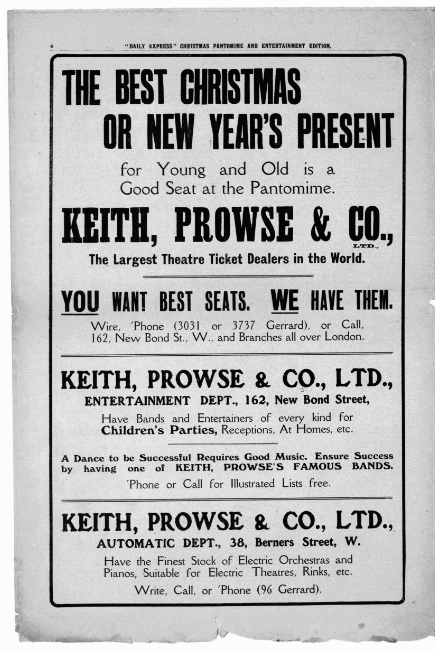
© May Moore Duprez Archive. Further reproduction prohibited without permission.
Pantomime dates back to the sixteenth century and has its roots in the Italian ‘Commedia dell’Arte.’ Due to the restrictions surrounding the use of spoken language in performances, early pantomimes were largely visual and were often set to music. In 1843 the Theatres Act lifted this restriction and pantomimes closely resembling the ones we know and love today, soon became a popular form of family entertainment.
By the end of the nineteenth century, in true Victorian style, pantomime had reached new levels of extravagance. Performances could last up to five hours and featured enormous casts, popular fairy tale characters, principal boys, pantomime dames, extravagant set designs, live animals and magic tricks. The 1900 production of Sleeping Beauty and the Beast was one of the most elaborate and successful pantomimes ever produced at Drury Lane Theatre in London. Stage settings and scenes included a Fairy Parliament, a Tangled Forest, an Enchanted Crystal Garden, a grand staircase and several fountains. It became customary for pantomimes to open on Boxing Day, forever linking this entertainment with the Christmas period.
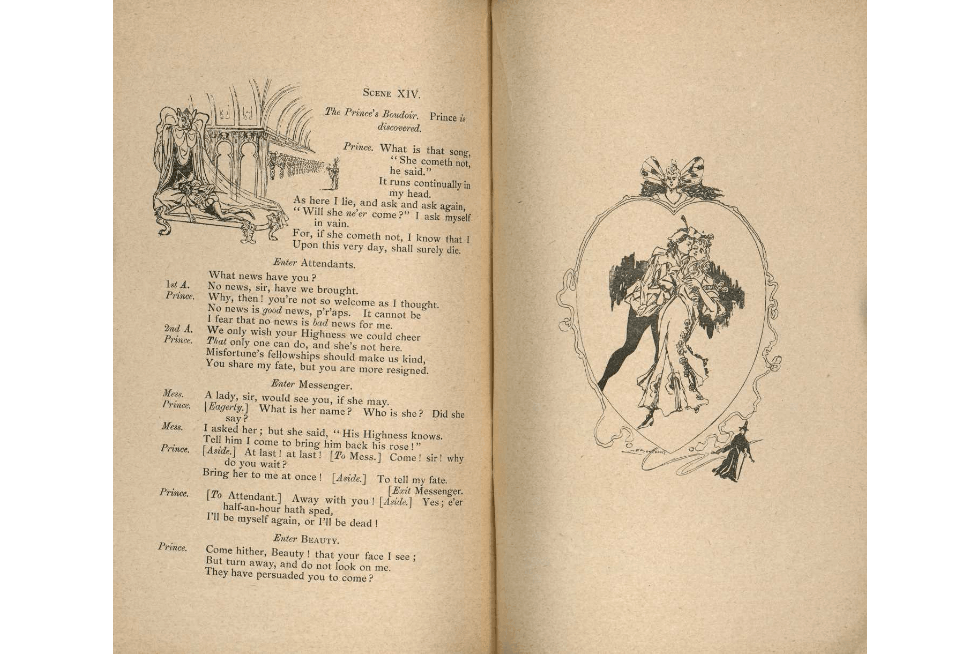
The Sleeping Beauty and the Beast, 1900, © Harry Ransom Center, University of Texas, Austin. Further reproduction prohibited without permission.
Our Victorian Popular Culture resource also contains a programme for an 1896 production of the renowned pantomime tale Jack the Giant Killer. This ‘Grand Comic Christmas Pantomime’ is loosely based on the English fairy tale that tells the story of a young boy called Jack who slays a giant. In this pantomime written by Stanley Rogers, the giant is named Blunderbore, ‘a greedy monster who never feels cold.’ Some of the other somewhat humorous characters include:
‘The Wonderful Cow, who, being particularly valiant, objects to a cowyard.’
‘Spareribs Brisket, the Giant’s cooks, whose recipes cannot be Beeton.’
‘Simple Simon, particularly fond of pies, a youth of much piety.’
‘Margery Daw, a young lady with strong views on matrimony. She thinks paupers have no right to a union.'
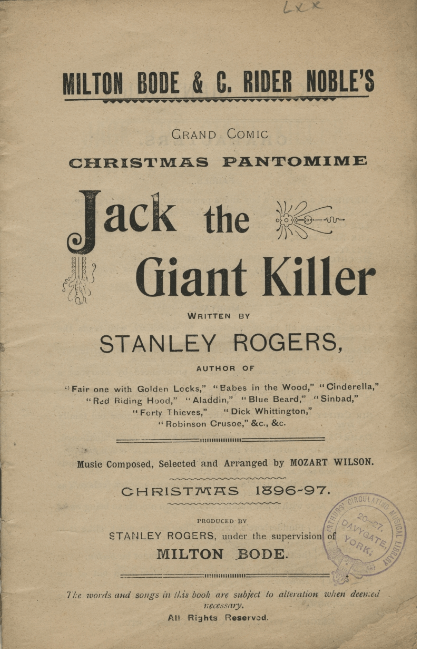
© Harry Ransom Center, University of Texas, Austin. Further reproduction prohibited without permission.
For more information on Victorian Popular Culture, including free trial access and price enquiries, please email us at info@amdigital.co.uk.
Recent posts

Noor Inayat Khan's story, revealed through wartime intelligence records, uncovers the realities of espionage and the extraordinary courage of a woman whose legacy challenges how we remember the Second World War.

Discover how Shakespeare’s earliest screen adaptations were never truly silent. Explore newly accompanied films and an early sound experiment featured in Shakespeare in Silent Film.