

Reconstructing climate history with AM Scholar
For historians of Eastern Africa, the nineteenth century remains a period marked by dramatic political, social, and environmental upheaval. Yet the documentary record for many inland regions is sparse. Dr Philip Gooding, a researcher at the Indian Ocean World Centre at McGill University, has spent the last eight years addressing this gap through systematic research of one of the few extensive source repositories available for this period: the Church Missionary Society Archive.
First photographed in microfilm reels from the Cadbury Research Library, Birmingham University, the resource was later made available online through the AM Scholar series.The missionary correspondence available in the Church Missionary Society Archive has allowed Dr Gooding to reconstruct localised climatic variations, analyse cascading societal impacts and reinterpret political events within an environmental framework, demonstrating how digitised archives enable historically grounded and interdisciplinary climate research.
Addressing geographical gaps in global climate research
Dr Gooding’s work with the Church Missionary Society Archive began within a large interdisciplinary project at the Indian Ocean World Centre investigating six long-term “environmental crises” across the Indian Ocean world, including the 1876-78 El Niño event, which coincided with his period of expertise.
While global analyses, such as Mike Davis’s Late Victorian Holocausts (2000), traced the effects of the El Niño famine across India, Northern China, and Brazil, Eastern Africa was conspicuously absent from previous accounts; not by design, necessarily, but because the documentary record for the region in this period is scattered and scarce. The Church Missionary Society Archive, with its rich correspondence from missionaries stationed across inland Eastern Africa, offered a rare window into late-nineteenth-century Eastern Africa, with unique textual density and chronological granularity.
The impact of digitising archives on research methods
Missionaries typically wrote home monthly, often enclosing diaries and observational material. This created a timeseries record impossible to reproduce from paleoclimatic proxies alone, as dating evidence from these latter sources involve significant margins of error.
The missionary sources... confirmed [the climatic event] and added a lot. Where the natural scientific sources were temporally imprecise, here I had the dates.

Bar chart showing rainfall anomalies in Mpwapwa, Tabora and Ujiji between 1855 and 1890, with alternating wetter and drier years.
Many of the surviving missionary sources are held in physical archives in Birmingham, London, Rome and Brussels. Church Missionary Society Archive is the only major missionary archive for this region and period that is fully digitised, which was a “game-changer”, in Dr Gooding’s words.
In addition to making the sources accessible in North America, the digitisation of these sources also made new research methods possible in their analysis. It enabled Dr Gooding to diverge from the reading order imposed by physical archival arrangement: instead of reading chronologically (as one must with boxes in a physical archive), he re-organised the sources by station, allowing him to track environmental change at specific sites (e.g. Kampala in Uganda or Tabora in Tanzania) across time.
This restructuring made it possible to trace patterns and anomalies in:
- Rainfall
- Drought and flooding
- Subsistence stress and famine
- Outbreaks of disease (including bubonic plague)
- Price fluctuations
- Political instability
Dr Gooding created a spreadsheet coding these themes from the letters and transcribing key quotations, with sender, date and station data, so that the themes could be compared systematically. He worked on two screens, with one displaying Church Missionary Society Archive images and the other the open spreadsheet, to allow iterative pattern recognition across hundreds of documents.
While this research method is not new, it shows how digitised primary sources enable scaled close reading. The resulting dataset offered a climate chronology extending from the 1870s to 1900 and made it possible to reconstruct not only what environmental anomalies occurred, but also how societies responded to them.
Reassessing political outcomes and public health crises in an environmental context
Analysing the Church Missionary Society Archive in this way revealed a period of climatic instability between the 1870s and 1880s. Missionary accounts, when read alongside paleolimnological data, identified a major flooding event in 1877-78 and repeated severe droughts in 1876, 1879–80, 1883-85, and 1886–88, in contrast with the relatively stable, abundant rainfall since the 1840s. This chronology provided new context for political developments that have long been documented but less often analysed environmentally, including the collapse of Mirambo’s state in 1884 and the civil conflict in Buganda in 1888-92.
“These well-known political events make much more sense when placed within a broader environmental context”
These crises unfolded amid an extreme, prolonged climatic downturn unlike anything in the previous forty years. This approach does not advance environmental determinism, Dr Gooding adds; rather, the climatic record illuminates the vulnerabilities and institutional stresses that shaped political outcomes.
Dr Gooding’s research also provided a framework for further comparative work across the Indian Ocean world, leading to studies on epidemic dropsy in Bengal-Mauritius and on drought related public health issues in Singapore. These projects used the research methods developed through the Church Missionary Society Archive to combine qualitative documentary evidence with climatological and epidemiological data to “fill in other global gaps”.
This interdisciplinary research has been published in peer-reviewed academic journals including Journal of Southern African Studies, Medical History and the International Review of Environmental History. An open-access climate reconstruction article in Climate of the Past, co-authored with climatologists, combines Church Missionary Society Archive data with atmospheric modelling and is available to read here: https://cp.copernicus.org/articles/20/2701/2024/

Church Missionary Society, G-3-A-6-O, Baxter to Wright, 21 February 1880, Mpwapwa. Image © The Church Mission Society. Further reproduction prohibited without permission.
Teaching with digitised archives
Although Dr Gooding’s primary responsibilities are research and administration of the Indian Ocean World Centre, digitised archives also shape his pedagogical practice. In guest lectures and in work with undergraduate research assistants, he uses Church Missionary Society Archive materials to demonstrate:
- How historians interpret handwritten nineteenth-century documents,
- How transcription affects interpretation,
- How researchers move from an individual document to a broader argument.
“I try to show students exactly how we get from a document to a published argument”, he says. Digitised collections can thus also play a role as teaching tools to support students’ primary source literacy and to help them understand how qualitative, human-created sources can be used as structured evidence in climate history and other fields.
Dr Gooding’s experience using the Church Missionary Society Archive speaks directly to the value of digitised archives in research and teaching. Without digitisation, rare primary sources in European archives would be impossible to research from North America in the same breadth and depth. Having ongoing access means documents can be checked again and again, when new findings come to light, instead of relying on notes made during an archive visit or trying to resource another trip on the other side of the Atlantic. When asked what he would lose without access to the Church Missionary Society Archive, Gooding states that “it would bring into doubt my ability to carry out my research”.
Digitisation, in this context, functions not simply as a preservation mechanism, but as a precondition for sustained scholarly engagement, particularly for regions historically underrepresented in global archives. For Eastern Africa, where written sources for the nineteenth century are limited, the Church Missionary Society Archive provides an essential repository of evidence. One that enables interdisciplinary climate reconstruction, reframing political and social histories and developing student research skills, from primary source literacy to interdisciplinary research methods.
Recent posts

Dr. Matthias Wong, National University of Singapore, teaches a module in digital humanities methodologies to support students across a wide range of subjects using AM Research Skills.
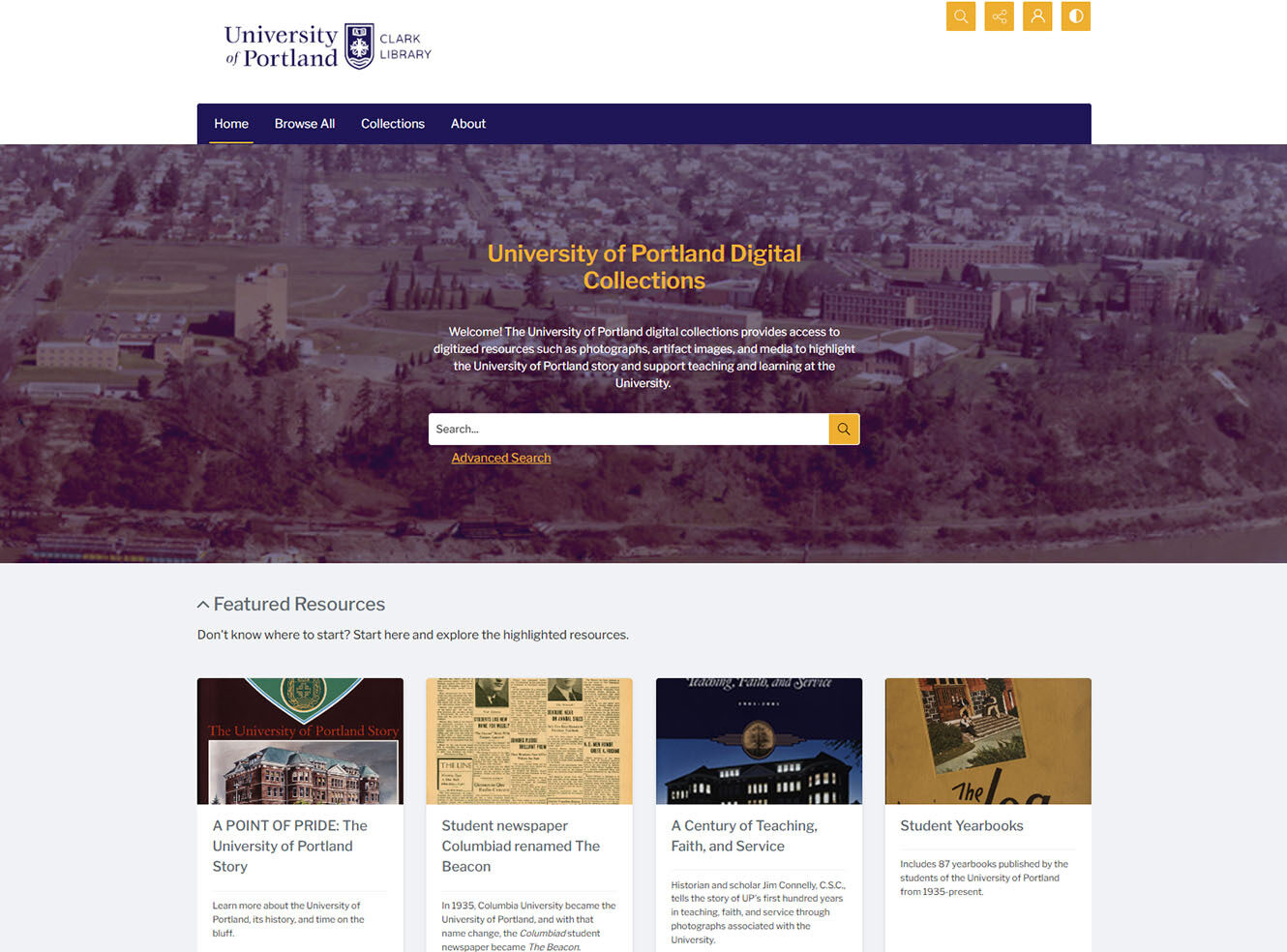
The University of Portland consolidated its digital assets and Scholarly Institutional Repository into a single, unified platform using AM Quartex, addressing inefficiencies and improving user experience. This transformation eliminated information silos, streamlined workflows and significantly enhanced the accessibility and discoverability of digital assets for both administrators and end-users.