

“What have the Romans ever done for us?”: Highlights from Food and Drink in History, module II
This week marks the publication of Food and Drink in History, module II, which adds a wealth of new material to a resource which spans centuries and offers users a unique lens through which to explore food histories, cultures and traditions from around the globe.
Apicius
A highlight from module II is the collection of editions of the so-called Apicius cookbook from the New York Academy of Medicine. Key to these documents is the 9th-century manuscript, De Re Culinaria. To make this unique and highly valuable document more accessible, it is accompanied in this resource by a specially commissioned modern English translation by Ken Albala, Professor of History at the University of the Pacific.
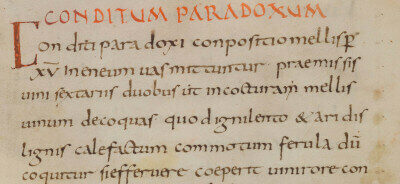
De re culinaria, Libri I-IX © The New York Academy of Medicine. Further reproduction is prohibited without permission.
In this translation, and the contextual essay and video interview also included in the resource, Ken Albala demonstrates how some of the roots of modern Italian cooking can be traced back to these Roman recipes, dating back to the 4th century AD or even earlier. The Apician Bread Salad is recognisable as an ancestor of the modern-day Panzanella; a blend of mint, rue, coriander and other basic ingredients is demonstrably an early type of pesto.
So, apart from the sanitation, medicine, education, wine, public order, irrigation, roads, the fresh-water system, and public health, we may have even more to thank the Romans for after all.
Julia Child Papers
“This isn't just boeuf bourguinon, it's Julia's boeuf bourguinon”. One of the key names appearing in module II of the resource is Julia Child. Her collection of papers from Schlesinger Library includes correspondence with individuals such as James Beard and her Mastering the Art of French Cooking collaborators Simone Beck and Louisette Bertholle, as well as documents relating to her series The French Chef and work with L’Ecole des Trois Gourmandes.
As such, the collection provides an insight not only into Child’s life and career but also into the development of the figure of the television chef, cookery education and the process by which French cuisine was introduced to the United States at large.
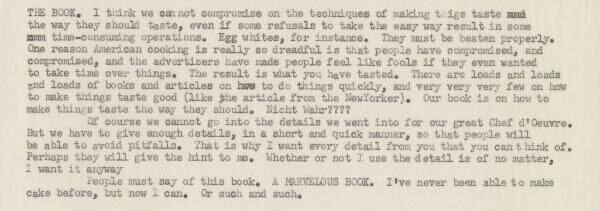
Child to Beck, Simone ("Simca"), Mar 1953 - Dec 1964, © Material sourced from the Schlesinger Library. Further reproduction is prohibited without permission.
New World wine
Wine, and specifically the development of the Californian wine industry, is a significant new area considered in module II. A highlight of the collection from California State Polytechnic University at Pomona are the Southern California Wine oral histories – interviews with key figures from wineries across the area, covering topics such as immigrant families’ experiences, prohibition, variation in winemaking and business techniques.
These recordings give a uniquely personal perspective on the New World wine industry throughout the 20th century and represent a fascinating route into the collection.
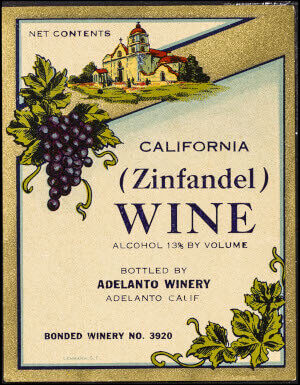
Adelanto Winery labels © Material sourced from California State Polytechnic University, Pomona. Further reproduction is prohibited without permission.
From a Roman gourmand renowned for extravagance and excess to late twentieth-century school meals and food stamp programmes, the documents in this module span nations and generations, facilitating research using food and drink as a means of interrogating how people have lived – how we have eaten, shared, cooked, farmed, fished, distilled and brewed – across centuries.
In doing so, it highlights the crucial place of food and drink in so many disciplines – histories of war, government and political movements, religious culture, economics, class culture, histories of race and migration, celebrity, social history, and many more.
To echo Julia Child, bon appétit!
About the collection
Food and Drink in History, module II is out now.
Recent posts

A snapshot of wartime Kabul, this piece highlights diplomatic intrigue, espionage, and shifting alliances in neutral Afghanistan, alongside broader themes of modernisation, geopolitical tension, and resistance movements during the Second World War.

Explore how newspapers reveal the personal alongside the political, from global events to everyday life. This blog uncovers striking public notices from Trinidad, where husbands and wives used the press to renounce responsibility for one another, offering a rare glimpse into relationships, gender roles and legal realities.