

Unfamiliar Letters: Annotations in an Early Modern ‘Epistolary Novel’
As an enthusiast of all things medieval and early modern, working on Adam Matthew’s newly-published resource, Early Modern England: Society, Culture and Everyday Life, 1500-1700, has been a wonderful experience. Among many personal highlights was the opportunity to visit the Shakespeare Birthplace Trust and assess their collection of early modern printed books, thirty of which have been digitised for the resource.
Many of these books are annotated, revealing much about how their readers engaged and interacted with their books. The annotations range from ownership inscriptions, reflecting how a book changed hands over the years, and notes recording family births and deaths over several generations, to doodles, marginalia and detailed commentary on the text. We may cringe when books are returned with dog-eared pages and unerased pencil, but, as a former student of codicology – the study of books as objects – I find the traces that readers leave of themselves on the page truly fascinating.

Image © Shakespeare Birthplace Trust. Further reproduction prohibited without permission.
There are few better examples of this than SBT 83378375, a copy of Epistolæ Ho-Elianæ. Familiar letters domestic and forren; divided into six sections, partly historicall, politicall, philosophicall, upon emergent occasions (1645). One of the earliest epistolary novels in English, it was written by James Howell, something of a jack-of-all-trades whose career included stints as a tutor, secretary, spy and agent for a glass company. The book is presented as a collection of letters to various friends and associates, covering a range of topics including politics, travel, philosophy, history and industry.
Almost every page of the book is covered in dense, rambling annotations; mostly in English or Latin but also occasionally in French, Spanish and Greek. Some of these discuss the individuals named in the text – sometimes admiring, sometimes mocking – while others offer political or religious commentary, and others still contain sayings, witticisms and more prosaic asides on everything from London churches to, believe it or not, the price of fish.
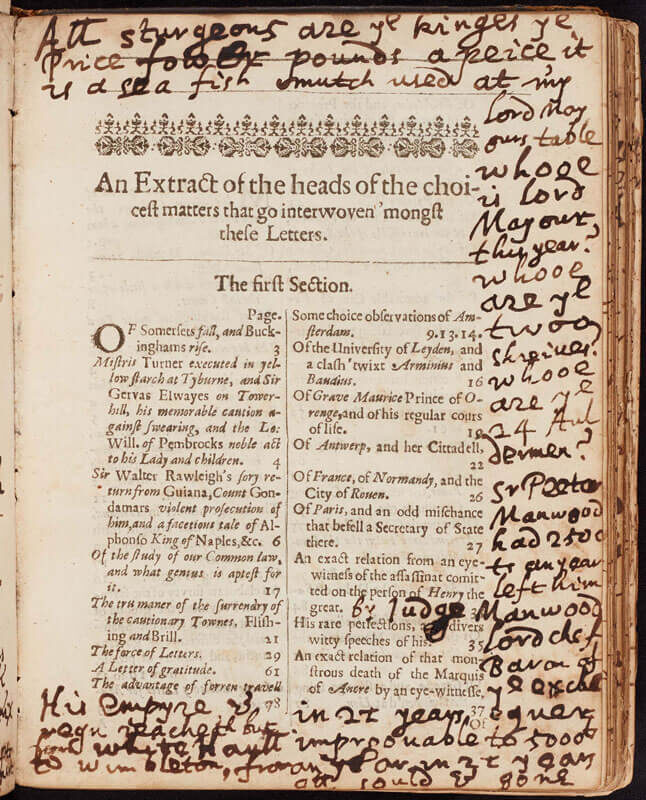
Image © Shakespeare Birthplace Trust. Further reproduction prohibited without permission.
The annotations have largely eluded scholarly attempts to make sense of them. Research notes left with the book suggest that they were the work of multiple hands, one of which may have been that of John Egerton, 1st Earl of Bridgewater (1579-1649). An Oxford-educated politician and former member of the Privy Council, Egerton would have been in his sixties, with a lifetime of experience informing his commentary. Other annotations may have been made by a John Milton – not the famous poet, but a native of Milton, Yorkshire.
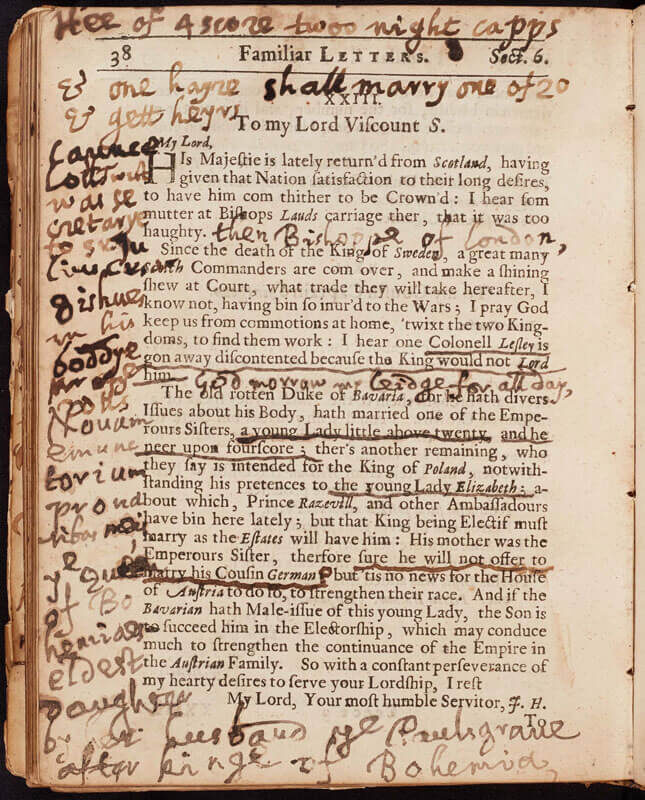
Image © Shakespeare Birthplace Trust. Further reproduction prohibited without permission.
While Epistolæ Ho-Elianæ, as an early epistolary novel, is an interesting text in its own right, the annotations in this copy offer a unique opportunity to view the text through the eyes of its early modern readers.
For more information about Early Modern England: Society, Culture & Everyday Life, 1500-1700, including booking a demo and price enquiries, please email us at info@amdigital.co.uk.
Recent posts

A snapshot of wartime Kabul, this piece highlights diplomatic intrigue, espionage, and shifting alliances in neutral Afghanistan, alongside broader themes of modernisation, geopolitical tension, and resistance movements during the Second World War.

Explore how newspapers reveal the personal alongside the political, from global events to everyday life. This blog uncovers striking public notices from Trinidad, where husbands and wives used the press to renounce responsibility for one another, offering a rare glimpse into relationships, gender roles and legal realities.