

St. Louis: the 'Northern City, with Southern Exposure': A special guest blog by Priscilla A. Dowden-White
This blog post has been written by guest blogger Priscilla A. Dowden-White, Ph.D, Associate Professor of History at the University of Missouri and Consultant Editor for the AM resource African American Communities.
Newly arrived African-American migrants to St. Louis during the opening of the Great Migration became part of an already established cosmopolitan community with deep roots dating back to the city’s early beginnings. A major centre of social welfare progressivism, St. Louis was also particularly wedded to residential segregation.
The two dynamics combined significantly to shape a strategy that African-American reformers devised to wrest concessions from a racially discriminatory power structure by tapping into ideas of good and efficient government, democratic citizenship, equitable social welfare services, labor peace and productivity, and community harmony.
The cultural dynamics that serve as a backdrop for African-American community development in St. Louis are fascinating. By 1920, St. Louis was home to the nation’s eighth-largest African-American urban community, with close to seventy thousand citizens representing 9 percent of the city’s total population. The ‘northern city with southern exposure’, was characterized by inconsistent patterns of segregation. Blacks and whites rode the streetcars together, and blacks could use the public library or visit the city’s grand municipal park, yet city playgrounds and swimming pools were segregated, and at the local ‘five and dime’, black customers were forced to eat at separate lunch counters.
Unlike cities further north, St. Louis consistently maintained racial segregated public schools like the neighboring cities to its south. However, the city put more money into its segregated schools for black children than did any southern city (and probably any northern city). St. Louis also maintained segregated public and private hospitals. Yet, in 1922, voters in the city passed an $87 million bond issue that would extend over $1 million to the creation of a hospital for indigent African Americans.
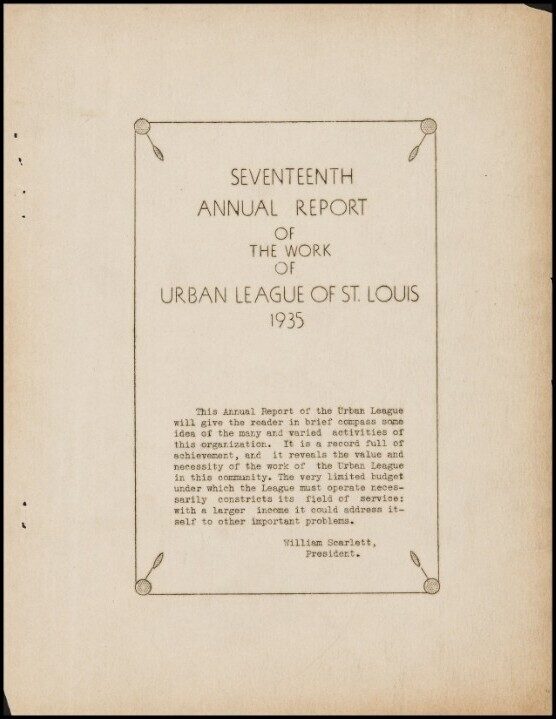
Image from African American Communities entitled: 'Annual report of the Urban League of St. Louis, 1935'. Image © Washington University in St. Louis. Further reproduction prohibited without permission.
In the racially self-conscious first half of the 20th century, heavily imprinted by the rhetoric and aspirations derived from two world wars, St. Louis as a case study further demonstrates that a singular form of racism and discrimination did not grip the nation during the Jim Crow era. The fact that black St. Louisans consistently retained the elective franchise and that community organizers operated within a small yet influential interracial social welfare network provided momentum for black reformers in their quest for the power to shape the city’s public culture. Yet, the 1916 segregation ordinance, the bombings of black residences in the 1920s, and the race restrictive covenants leading up to the U.S. Supreme Court ruling in Shelley v. Kraemer (1948), each served to demonstrate that white residents among the rank and file and their neighborhood maintenance representatives, were profoundly racist on housing issues.
St. Louis afforded African-American reformers unexpected opportunities during the Jim Crow era. In the 1920s and 1930s, the St. Louis Urban League (SLUL) was one of the National Urban League’s most progressive affiliates. The SLUL’s neighborhood clubs and block unit movement helped to nurture the seeds of mass-based community organizing. Despite their limited results, African-American social welfare reformers’ efforts to combat racial segregation, discrimination, and marginalization during the Jim Crow era, were in the vanguard of interwar period experiments in democratic community organization.
For more information about African American Communities, including pricing, please request a demo.
Recent posts

Noor Inayat Khan's story, revealed through wartime intelligence records, uncovers the realities of espionage and the extraordinary courage of a woman whose legacy challenges how we remember the Second World War.

Discover how Shakespeare’s earliest screen adaptations were never truly silent. Explore newly accompanied films and an early sound experiment featured in Shakespeare in Silent Film.