

"In Serious Verse": the politics and poetics of Caroline Norton’s "A Voice from the Factories"
In a time when women could not govern democratically, Caroline Norton mobilised the power of poetry to mount political campaigns – and successfully reformed the legal rights of women in the process.
Beautiful, quick-witted but with her family in reduced circumstances after her father’s death in South Africa, the 19-year-old Caroline Sheridan married George Norton, a barrister, Tory MP for Guildford and ten years her senior, to help her mother’s unstable financial situation. Lord Melbourne, the Whig Prime Minister, called her husband “a stupid brute” and in 1836, Caroline left her unhappy and abusive marriage.
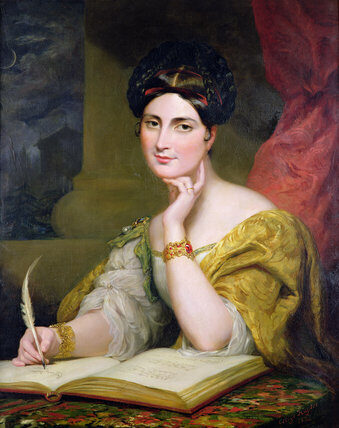
Caroline Norton (1808-1877), social reformer and John Murray author. Portrait by George Hayter, n.d. Access via Wikimedia Commons.
George retaliated by taking her independent earnings from writing, abducting their three children and suing Lord Melbourne for “criminal conversation” with Caroline (Victorian legalese for adultery) in a scandal that sent shock waves through Victorian England and was fictionalised by Charles Dickens in The Pickwick Papers.
That same year – quite possibly the most tumultuous of her life – Caroline’s poem "A Voice from the Factories" was published by John Murray. Her poetry, like her life, refused to conform to expectations. Caroline uses the verse form Edmund Spenser created for his allegorical Tudor epic The Faerie Queene: the Spenserian stanza. Works like Lord Byron’s Childe Harold's Pilgrimage, which took the John Murray publishing house by storm, revived the form in the early nineteenth century.
Caroline’s adoption of it firmly situates the shape of her poem in the fashionable literary circles of the younger rebel generation of Romantics, while refashioning its association with travel, legend and melancholy fatigue of aristocratic men by dealing with the pressing social and political concerns of her day: child labour, class difference and poverty.
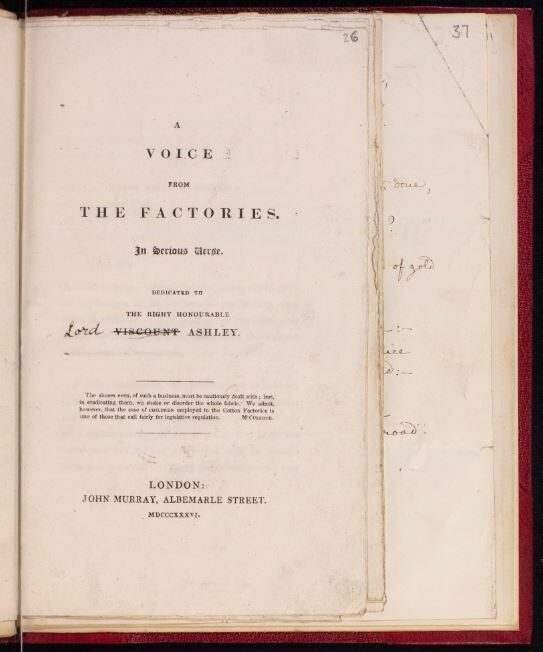
Caroline Norton's "A Voice from the Factories" (1836). © National Library of Scotland. Further reproduction is prohibited without permission.
In The Lotos-Eaters, published four years before "A Voice from the Factories", Alfred Lord Tennyson uses the final, longer hexameter line characteristic of the Spenserian stanza to perform the languid impotence of drugged heroes from Greek legends. Norton’s final lines can sound like a cry at a political rally, a heckle in the audience that holds those on the stage accountable, with the intensity of a collective address:
Saved for your children! Fathers, is there not a plaintive magic in the name of the child, which makes you feel compassion for their lot on whom prosperity hath never smiled? When with your OWN an hour hath been beguiled (for whom you hoard the still increasing store), surely, against the face of pity mild, heart-hardening custom vainly bars the door. For that less favoured race.
Should there be any mistake in her intentions for the effect of the poem, Norton adds "In Serious Verse" under the title of the poem. Even her epigraph comes from John Ramsay McCulloch, a Scottish political economist who edited Adam Smith’s The Wealth of Nations. For Caroline, political campaigning and writing poetry went hand in hand: she devoted the rest of her life to campaigning for women’s rights which led directly to the passing of the Custody of Infants Act 1839, the Matrimonial Causes Act 1857 and the Married Women's Property Act 1870.
In many ways, her poetry anticipates Mario Cuomo’s sentiment that you govern in prose, but “campaign in poetry”. In a time when women could not govern democratically, Caroline mobilised the power of poetry to mount political campaigns – and successfully reformed the legal rights of women in the process.
For more on strong, independent women see our blog on Spenser's Britomart here.
For more information on Nineteenth Century Literary Society: The John Murray Publishing Archive, including pricing, please request a demo.
Recent posts

A snapshot of wartime Kabul, this piece highlights diplomatic intrigue, espionage, and shifting alliances in neutral Afghanistan, alongside broader themes of modernisation, geopolitical tension, and resistance movements during the Second World War.

Explore how newspapers reveal the personal alongside the political, from global events to everyday life. This blog uncovers striking public notices from Trinidad, where husbands and wives used the press to renounce responsibility for one another, offering a rare glimpse into relationships, gender roles and legal realities.