

Barbie: the formative years
Nowadays, almost everything in the current market for children’s toys seems to require batteries; if it hasn’t got flashing lights, touch screens and loud electronic noises emanating from it, kids aren’t interested. A far cry from my own childhood when Gymnast Barbie (complete with co-ordinated gym bag, sweat-bands and multi-coloured leotard) was enough to keep me entertained for hours!
Speaking of my old friend Barbie brings me on to a fascinating report that I discovered amongst our digitized collection of papers written by Ernest Dichter[1] and his Institute for Motivational Research . A perfect example of his “consumer focus group”, this report is an observation of a group of young girls (aged 8-12) and their mothers when given a selection of Barbie-prototypes to play with back in 1958.
The following tape-recorded comments came from four girls aged 11-12:
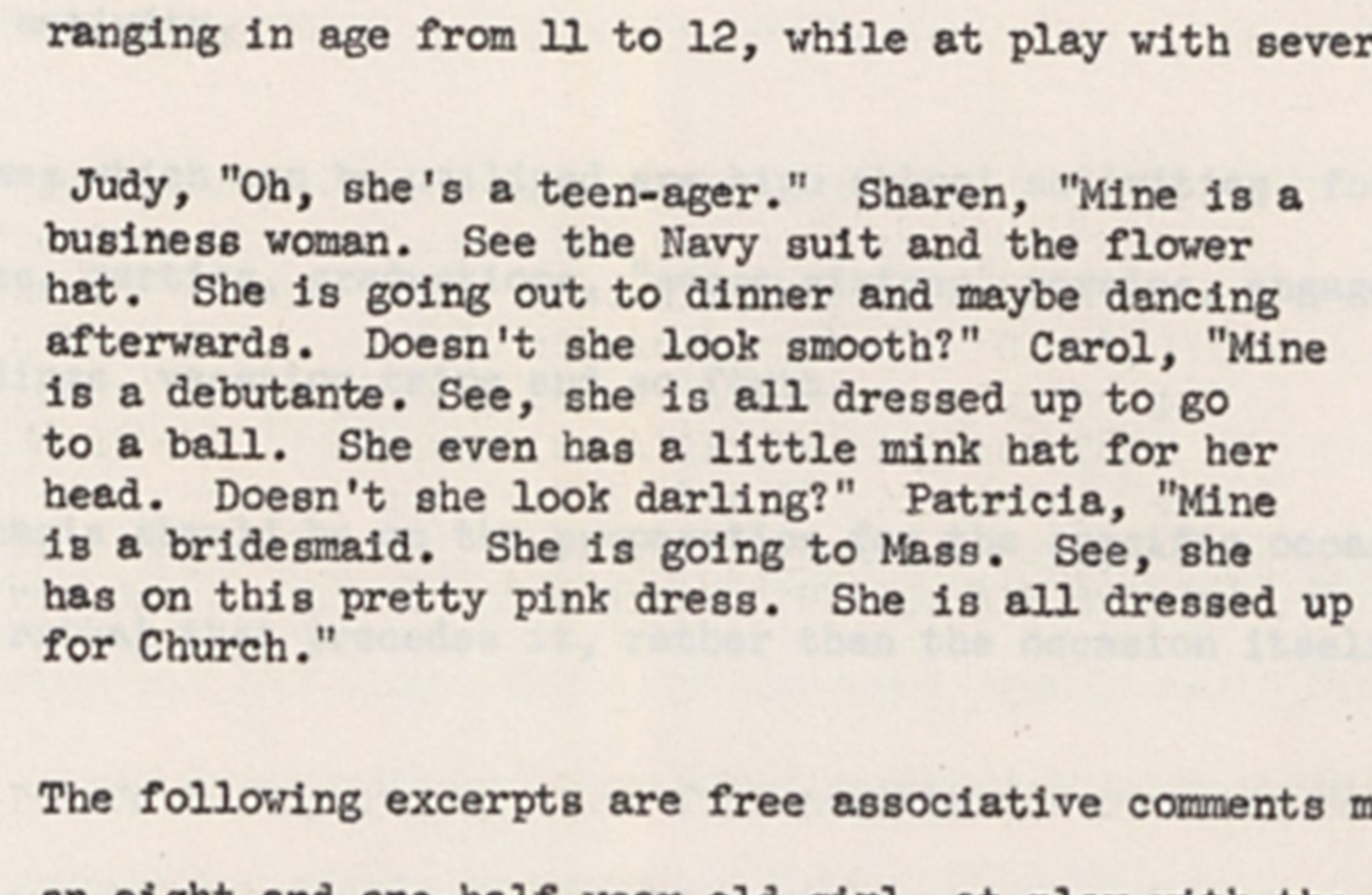
A motivational research study in the field of toys..., Jun 1959, © Hagley Museum and Library
These initial reactions are certainly endearing but the observations quickly turn to the doll’s appearance and figure. Turning the doll over in their hands, the children comment “she is really grown-up” (that’s one way of putting it!) whilst the mothers express concern at the “sexy” appearance of the doll: “this is a daddy doll” one parent comments, “they could be a cute decoration for a man’s bar”.
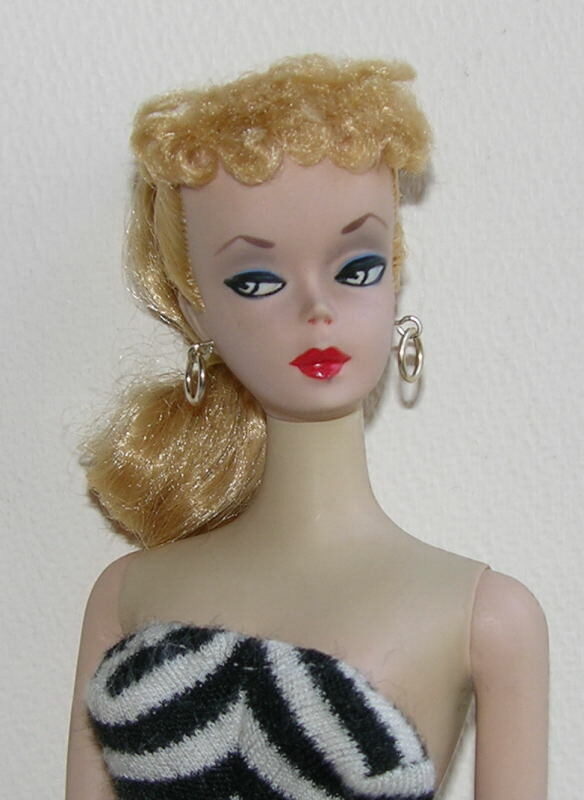
Despite these comments, the only thing that Mattel subsequently altered with regards to Barbie’s appearance was her eyebrows and heavy eye make-up as the children thought she looked “haughty” and “snobbish”. However, Barbie’s “sexy” figure has become her trademark. To this day (at the age of 54) she boasts a teeny-weeny waist, impressive bust and legs up to her arm-pits. A recent study found that if you scaled up the Ken doll’s proportions to human-size, you would find it in around 1 in 50 men. However, Barbie’s proportions are to be found in only 1 in 100,000 women which lends weight (excuse the pun) to the argument that unnecessary pressure is put on young girls to be an unrealistic size.
Whether young girls are quite so easily influenced is debatable. The complete report and others on the consumer market from 1935-1965 are published in Market Research and American Business, 1935-1965
[1] Ernest Dichter was an Austrian-American psychologist and marketing “guru” who came to be known as the “father of motivational research”. He used the psycho-analytics of his Freud-inspired education to study consumer behaviour and relay that information back to the advertisers to manipulate the market accordingly. According to a New York Times article in 1998, he "was the first to coin the term focus group and to stress the importance of image and persuasion in advertising".
About the author
Lauren Jones is a Publishing Manager at AM.
About the collection
Market Research and American Business, 1935-1965 is out now.
Recent posts

A snapshot of wartime Kabul, this piece highlights diplomatic intrigue, espionage, and shifting alliances in neutral Afghanistan, alongside broader themes of modernisation, geopolitical tension, and resistance movements during the Second World War.

Explore how newspapers reveal the personal alongside the political, from global events to everyday life. This blog uncovers striking public notices from Trinidad, where husbands and wives used the press to renounce responsibility for one another, offering a rare glimpse into relationships, gender roles and legal realities.