

Alexander Hamilton and the Reynolds Pamphlet
If you love nothing more than a smash-hit stage musical to ignite a keen interest in revolutionary history, then I’d encourage you to look no further than American History, 1493-1945 where you can find a trove of documents from the Gilder Lehrman Institute on the rise and fall of Alexander Hamilton.
For those who aren’t familiar with the show Hamilton, Alexander Hamilton was one of the founding fathers of the United States of America and was, influential in shaping the Constitution and the nation's financial system after the revolution. While he passionately debated and provoked his political enemies throughout his career, many of his contemporaries believed he was on a trajectory towards the Presidency.
That is, until the infamous Hamilton-Reynolds affair, Hamilton had an affair with a woman called Maria Reynolds. Her husband James Reynolds blackmailed Hamilton in exchange for keeping the affair a secret, and then tried to accuse Hamilton of financial speculation. In an attempt to salvage his political reputation, Hamilton published a pamphlet to deny the charges of speculation but publicly admitted to the affair in what would be the first major American political sex scandal.
A copy of the pamphlet “Observations on Certain Documents…” or, as it came to be known, the Reynolds Pamphlet, can be found in the AM American History collection. The document is a fascinating insight into Hamilton’s life and work as he wrote in detail a defence of his actions and his character.
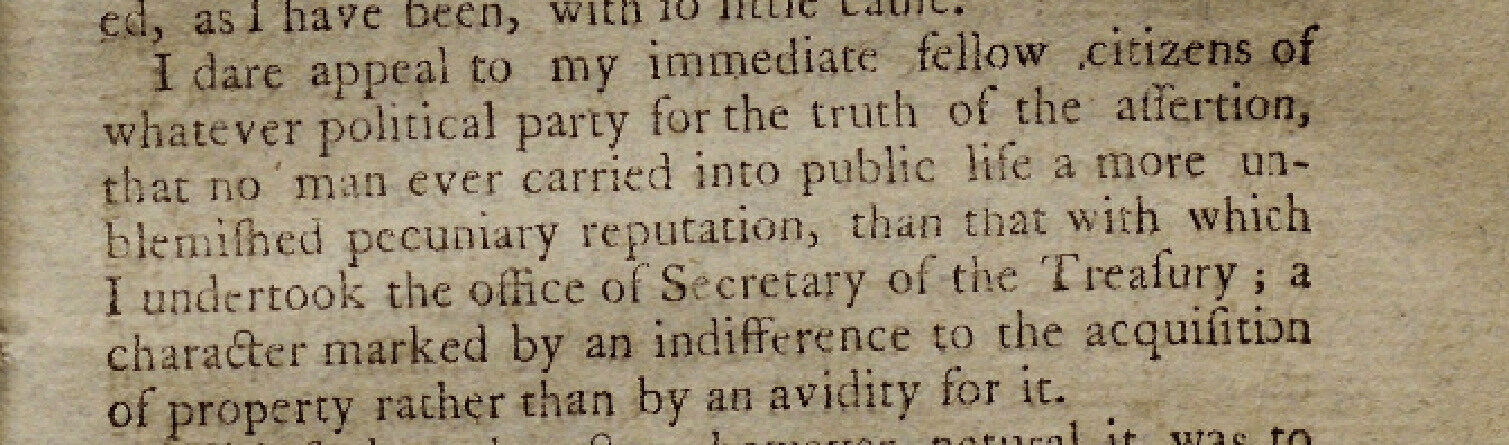
Observations on certain documents contained in... ..., 1797, GLC05649.01, © The Gilder Lehrman Institute of American History. Further reproduction prohibited without permission.
Hamilton made it clear throughout the pamphlet that his priority was to protect his reputation. His opening remarks are an appeal to his reading public to believe in the honourable intentions of his career in public life.
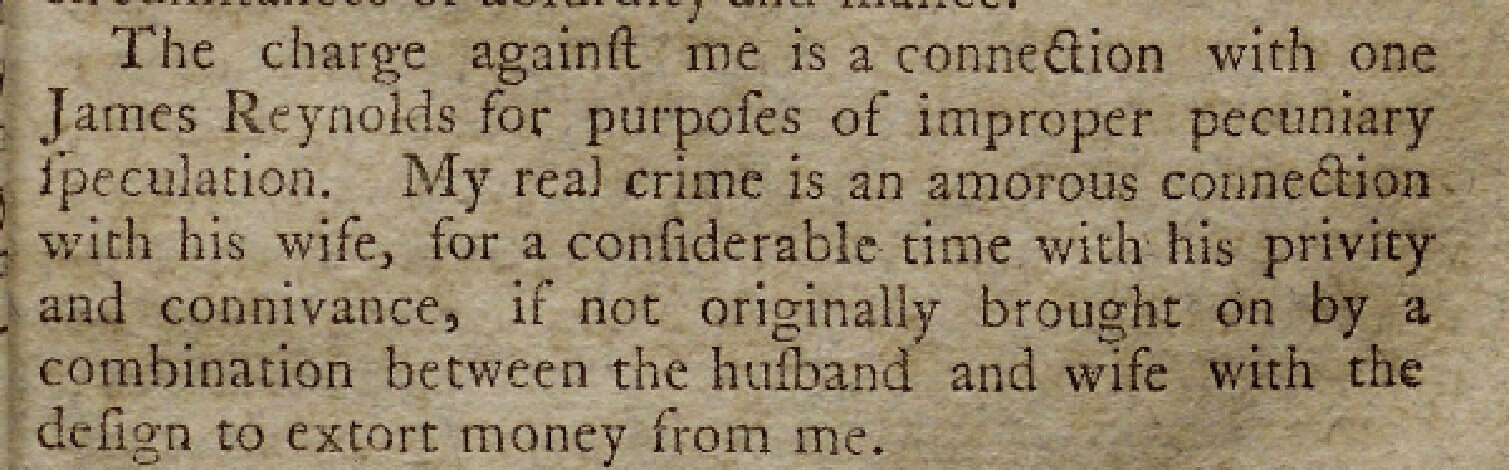
Observations on certain documents contained in... ..., 1797, GLC05649.01, © The Gilder Lehrman Institute of American History. Further reproduction prohibited without permission.
It is here on page nine Hamilton makes his shattering admission of adultery, and on the following page he writes quite directly about the necessity of his confession in order to defend himself against “a more heinous charge”.
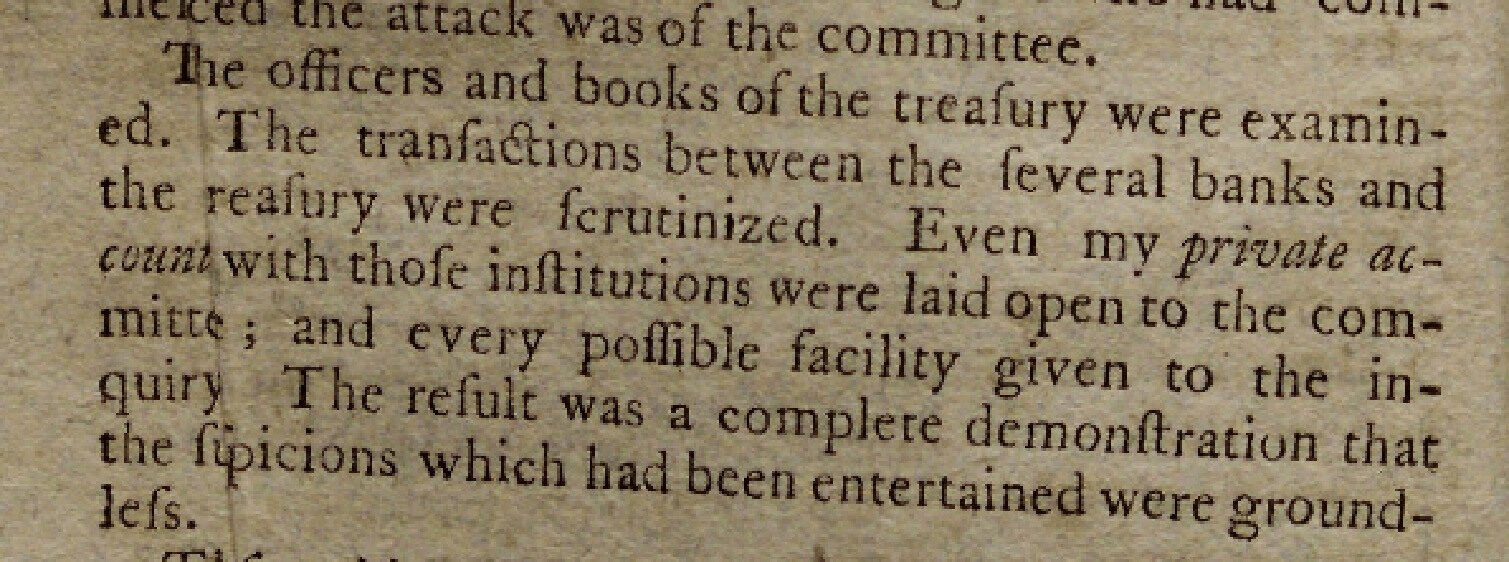
Observations on certain documents contained in... ..., 1797, GLC05649.01, © The Gilder Lehrman Institute of American History. Further reproduction prohibited without permission.
It is intriguing to read Hamilton describe in meticulous detail the events leading up to the affair and the subsequent blackmail and extortion by James Reynolds. He describes precise sums of money that he paid to Reynolds, the ordeal of his personal accounts being searched for evidence of wrongdoing, and the process of his acquittal in the House of Representatives – all the while he scarcely mentions the betrayal to his wife. Most boldly, Hamilton published in the pamphlet, letters from his accusers and original letters from Maria Reynolds.
Hamilton believed he could save himself by exposing the truth, but his marriage and his career suffered, and his life was cut tragically short just a few years later in a deadly duel with his lifelong opponent, Aaron Burr. But despite this scandalous affair, Hamilton’s legacy today is held in higher esteem and is much more well known now thanks to the global success of Lin-Manuel Miranda’s musical. To quote Miranda’s lyric on Hamilton's downfall “...Legacy, what is a legacy?”.
For more information about American History, 1943-1945 including pricing, please request a demo.
Recent posts

Explore how newspapers reveal the personal alongside the political, from global events to everyday life. This blog uncovers striking public notices from Trinidad, where husbands and wives used the press to renounce responsibility for one another, offering a rare glimpse into relationships, gender roles and legal realities.

Noor Inayat Khan's story, revealed through wartime intelligence records, uncovers the realities of espionage and the extraordinary courage of a woman whose legacy challenges how we remember the Second World War.