

The Haunted Swing: something wicked this way rotates...
With Halloween only days away, it’s once again time to dust off the face paints, shine-up the vampire fangs and artistically destroy a pumpkin. To help you get into the "horror" of things, we've searched through our resources and uncovered a suitably ghoulish photogravure of an amusement ride called ‘The Haunted Swing,’ from an 1894 souvenir album for San Francisco’s California Midwinter International Exposition.
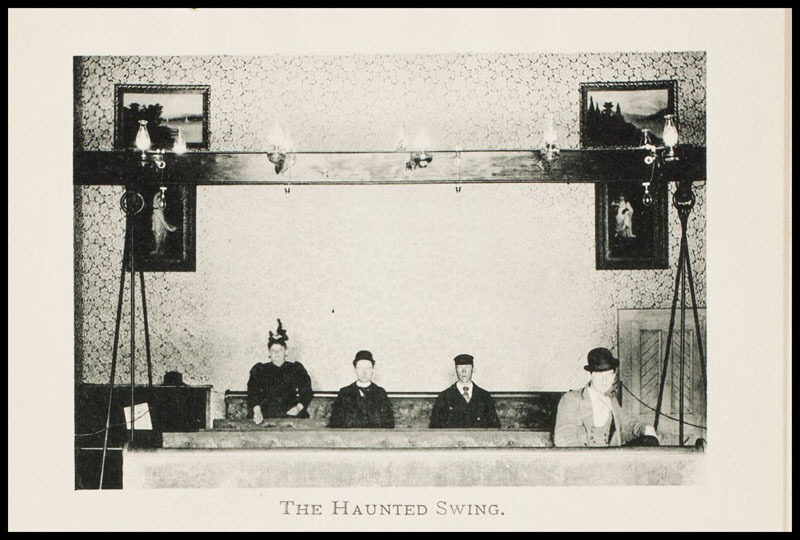
©Special Collections Research Center, Henry Madden Library, California State University, Fresno. Further reproduction prohibited without permission.
Invented by Amariah Lake in the early 1890’s, the Haunted Swing became a popular attraction and appeared as part of the Midwinter fair’s ‘Midway Plaisance’ amusement area. Admittedly, this photograph portrays a fairly innocuous scene devoid of any of the typical horror clichés such as solitary rocking chairs, sallow-looking children or tormented wraiths. However, this clever contraption was concerned with procuring a different type of fright.
Located in the middle of a traditional sitting room interior, the swing was suspended from a bar across the ceiling and could accommodate approximately 15 people. When the ride began, the swing appeared to move back and forth at an increasing pace until it seemed to complete a full rotation and its participants were imbued with the sensation of hanging upside down whilst inexplicably defying the rules of gravity. In reality it was the walls of the make-shift room which rotated (bolted-down furniture and all) whilst the swing itself hardly moved. But the illusion was so cleverly coordinated that participants would emerge confused, dizzy, faint, and often nauseous.
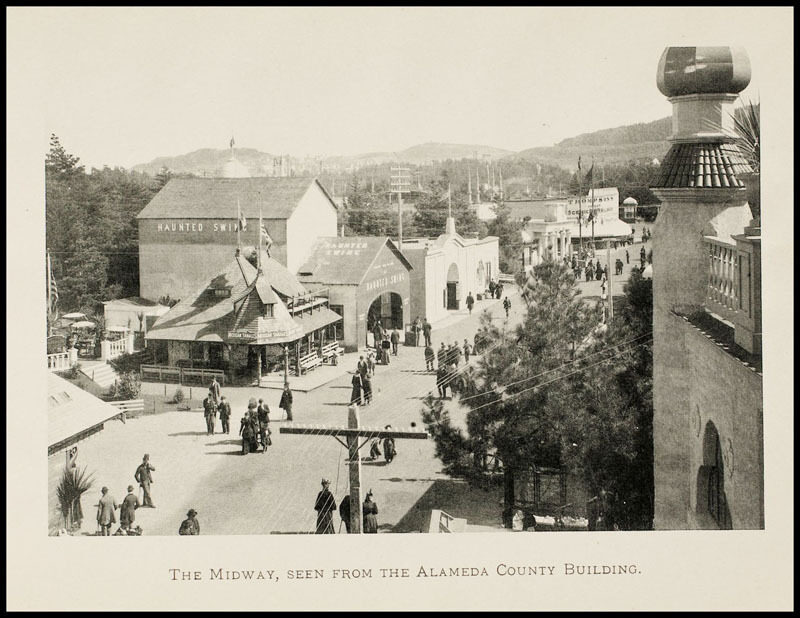
An external view of ‘The Haunted Swing’ building situated on the fair’s ‘Midway Plaisance’.
©Special Collections Research Center, Henry Madden Library, California State University, Fresno. Further reproduction prohibited without permission.
Whilst The Haunted Swing may seem tame in comparison to the blood splattered, special effect-laden, Hollywood horrors to which we have all become accustomed, during the 1890’s when logic and progress reigned, this ride exposed a vulnerable disconnect between the mind’s ability to reason and the body’s ability to perceive. It highlighted the frightening fact that the body and the mind are vulnerable to manipulation and cannot always be trusted, a fear popularised in classic Gothic horrors of this period such as Robert Louis Stevenson’s Strange Case of Dr Jekyll and Mr Hyde, or Bram Stoker’s Dracula. And, as is demonstrated by the prevalence of modern-day incarnations of Lake’s Haunted Swing in fairgrounds across the world, this fear is as perpetual as the rotations of the ride itself.
For more information on World's Fairs: A Global History of Expositions, including pricing, please request a demo.
Recent posts

A snapshot of wartime Kabul, this piece highlights diplomatic intrigue, espionage, and shifting alliances in neutral Afghanistan, alongside broader themes of modernisation, geopolitical tension, and resistance movements during the Second World War.

Explore how newspapers reveal the personal alongside the political, from global events to everyday life. This blog uncovers striking public notices from Trinidad, where husbands and wives used the press to renounce responsibility for one another, offering a rare glimpse into relationships, gender roles and legal realities.